AI transformation and enablement
Why AI experiments die, and how to get them into production
A successful proof of concept is not the same as a useful product. The gap between them is where most AI initiatives lose momentum.
AI experimentation has made it easier than ever to show what a model can do. A team can build a convincing demonstration in days. It can summarise a document, draft a response or answer a question well enough to create excitement. Then the work stalls.
The issue is rarely that the original idea was technically impossible. More often, the experiment was built in isolation from the people, systems and decisions it needs to support. A proof of concept can work in a vacuum while leaving the harder questions unanswered: who will use it, what happens when it is wrong, where does it sit in the workflow and how will it be operated safely?
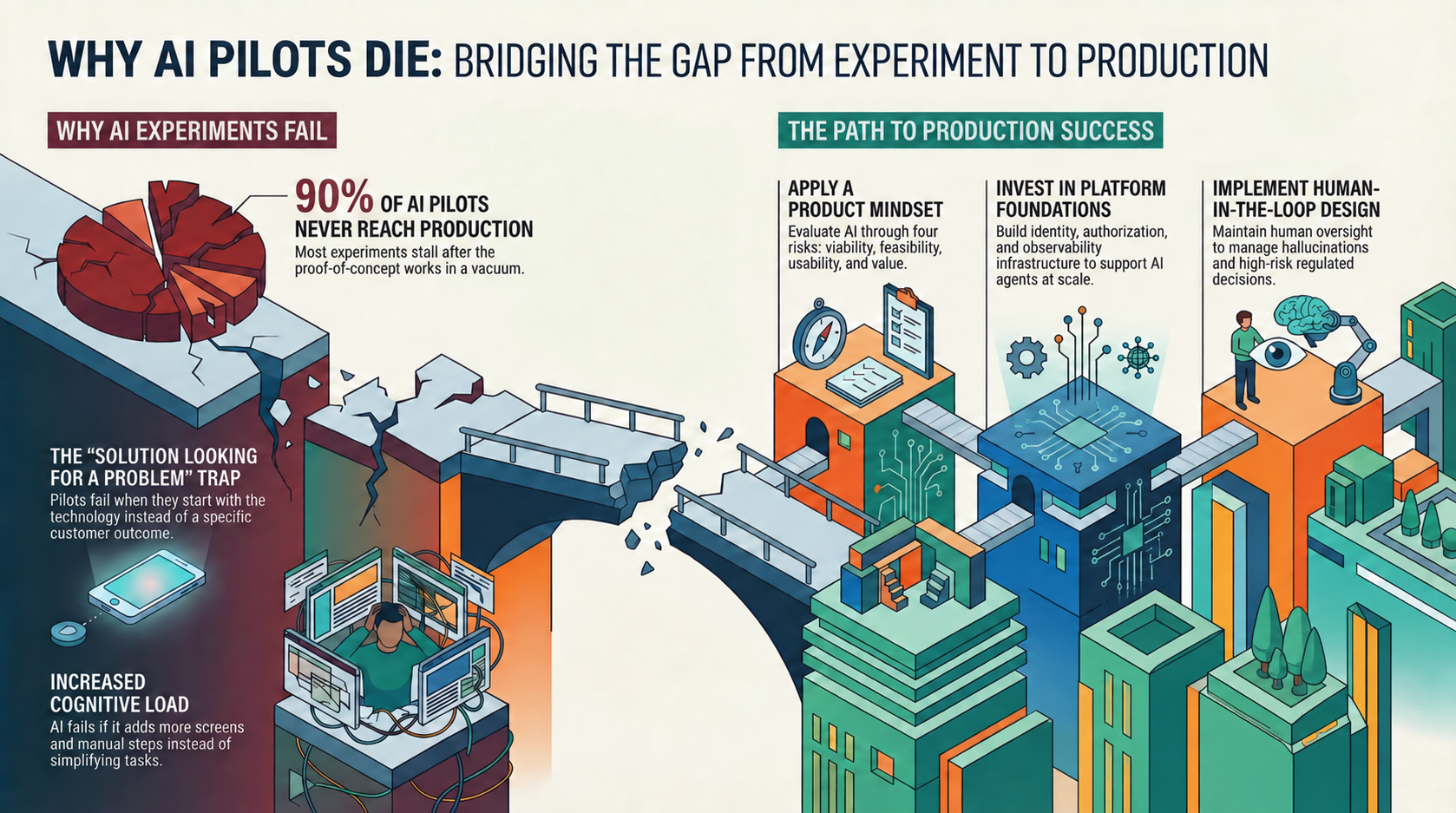
The solution-looking-for-a-problem trap
Many pilots begin with the technology rather than an outcome that matters to a customer or team. The question becomes, “Where can we use AI?” instead of, “What important piece of work should become easier, faster or more reliable?” That framing makes it easy to build something interesting and hard to build something people need.
Start with a specific workflow and a measurable problem. Look for work with enough volume to matter, a clear owner and a pain point that users already recognise. The AI capability should earn its place by improving that work, not by adding another destination for people to visit.
A pilot has a path to production when it solves a real problem in a way that fits the work around it.
Design for less cognitive load
An AI feature can create more work even when its outputs are useful. If people have to copy information between screens, interpret an unfamiliar answer, check every result manually or remember a separate process, the feature may increase cognitive load rather than reduce it.
Product design is how teams avoid this. Put the capability where the decision or task already happens. Make the next action clear. Preserve context instead of asking users to restate it. Test the workflow with real cases, including the awkward ones, before assuming that a good demo will translate into adoption.
Use a product mindset to decide what is viable
Production work calls for broader judgement than a model evaluation. A useful way to assess an AI opportunity is through four questions: is it viable, feasible, usable and valuable?
- Viable: Does it support a priority outcome, and is there a clear owner for the change?
- Feasible: Can it access the right data and systems, perform reliably enough and meet security requirements?
- Usable: Can people understand the output and incorporate it into their existing work without unnecessary effort?
- Valuable: Does it improve flow, quality, customer experience or commercial results enough to justify its ongoing cost?
These questions do not slow a pilot down. They help a team learn the right things early, before it commits to a solution that cannot survive outside a controlled environment.
Build the foundations before scale exposes the gaps
Experiments often rely on manual setup, permissive access and a small group of experts who understand the context. That is reasonable for learning. It is not an operating model. As usage grows, the gaps become visible: unclear identity and permissions, brittle integrations, missing observability and no dependable way to evaluate changing model behaviour.
Platform foundations make an AI capability repeatable. This includes identity and authorisation, secure access to data, logging and monitoring, quality evaluation and a clear way to manage prompts, models and changes. Teams do not need to build every foundation at once, but they should know which ones are required for the use case they intend to scale.
Keep people where judgement matters
Human-in-the-loop design is not a fallback for weak AI. It is a deliberate choice about responsibility. In high-risk, regulated or ambiguous work, people need to review, correct or approve AI-supported outputs. The design should make that oversight efficient, not turn every result into a time-consuming audit.
Be explicit about what the system can recommend, what it can do automatically and when it must hand work back to a person. Give users enough context to challenge an output. Capture feedback and exceptions so the team can improve the workflow, the instructions and the safeguards over time.
Turn the pilot into a production decision
A pilot should reduce uncertainty, not simply prove that a model can generate an answer. Before it begins, agree the workflow to improve, the evidence that would justify the next investment and the conditions that would make the team stop or redesign the approach.
That shifts the conversation from a demonstration to a product decision. It gives teams permission to learn from results that are not ready to scale and a clear basis for investing when the evidence is strong. The path to production is built from product judgement, practical foundations and thoughtful human oversight, one real workflow at a time.